Sunday, May 31, 2009

But The Good News Is...

Fists, Lithuania 2007 © Andrew Miksys
Certain factions of the GOP are showing their true colors over the Sonia Sotomayor nomination.

But the good new is...

I’ve been thinking a lot about photo books lately as I begin the arduous but enlightening process of making a maquette for Stranded. So I was happy when news of two compelling new books came my way.

From Not Niigata © Andrew Phelps
Andrew Phelps is offering a pre-sale special edition of his upcoming book Not Niigata. When you purchase the special edition you will receive it before the official release date plus you can choose any image from the book and Andrew will send you a print. Sounds like a great deal. Contact Andrew directly to find out more.

From Your Golden Opportunity is Comeing Very Soon © RJ Shaughnessy
RJ Shaughnessy continues the liberating trend of the self-published book with the very intriguing Your Golden Opportunity is Comeing Very Soon. He was kind enough to send me a signed copy. The book features images of what appear to be urban crash sites taken at night with Weegee-esque flash. RJ has limited the number of books to 500 and each includes a hand written edition marking and signature. It’s available at Dashwood and Colette.

The super talented photographers Juliana Beasley and Andrew Miksys along with four others have won the 2009 Siskind Foundation grant. Congratulations to them on this well-deserved honor.

Tuesday, May 26, 2009

Leda and the Swan

Leda and the Swan, Cesare Sesto
The myth of Leda and the Swan is disturbing. Zeus takes the form of a swan and rapes Leda on the same night she sleeps with her husband. Leda then give birth to four children; two by her husband and two by Zeus hatched from eggs. Leda and the Swan is a common motif in Italian Renaissance art, but it is always painted or sculpted as a highly erotic encounter. Like being raped by a swan and giving birth to bastard egg children is the height of eroticism.

Leda and the Swan, Bachiacca
Last week I was at the Met and saw no less than four pieces depicting the Leda motif. They all reminded me of an older photograph I took while crashing a random child's birthday party in Port Jervis, NY. Where the classic depiction of Leda and the Swan is all amorous smiles and post-coital glow, I think this image might be a more authentic depiction of Leda's reaction to the experience.

The Swan © Amy Stein

Thursday, May 21, 2009

Does Living Abroad Spark Creativity?

Ernest Hemingway at the Finca Vigia, Cuba, 1953, JFK Presidential Library and Museum
A recent piece in The Economist highlights a study in the Journal of Personality and Social Psychology that suggests living abroad may do wonders for your creativity. The results certainly seem intuitive. I've lived abroad and the experience shook up my influences.

But, not so fast says Jonah Lehre on his blog, The Frontal Cortex. He thinks the conclusions in the study may be sketchy and cites issues of causation vs. correlation and using email as a testing tool as factors.

This matter is too important to leave open for debate. We need certainty and I'm willing to step up and be a guinea pig. Scientists, please send me to Spain with my camera, pump me full of sangria and hook me up to any all manner of diodes and testing apparatus you have. Let's get to the bottom of this pressing scientific matter once-and-for-all.

Wednesday, May 20, 2009

Herb and Dorothy

This documentary looks really interesting. It's screening at Cinema Village on June 5.

New York Photo Festival, Come On!

Exhibit A
I want to start this post with two huge caveats. First, I am eternally grateful to the New York Photo Festival. Last year they chose Domesticated for the NYPH book prize and I have no doubt that award has opened doors for my career. Second, I am incredibly honored any time someone wants to exhibit my work.

Now, to the business at hand.

An event that bills itself as "The Future of Contemporary Photography" should hold the photographic image and photographers in the highest regard. They should NOT:
  • Issue a press release announcing an exhibition with a group of photographers before contacting said photographers and asking them if they want their work included in the show
  • Respond to a photographers request that they would like to print and frame their own work with a list of polite excuses why it's not possible while not admitting that perhaps the real reason is that they have sold printing duties as part of a festival sponsorship package
  • Present multiple images printed on a single sheet of paper and tacked to a piece of plywood
  • Be so careless as to not recognize the proper and obvious orientation of a photo
Exhibit B
I was out of the country during the festival, but received several emails from friends alerting me to how my work was presented. When I returned I saw the photos my husband took and was both disheartened and angry.

I thought long and hard about writing this post because I really want the New York Photo Festival to succeed, but as an artist all I have is my work. I invest blood, sweat and tears into each photograph and want it to be presented in the best light possible. I fully support creative exhibition choices and cutorial vision, but I suspect neither was at work here. This was just sloppy execution and an embarrassment for everyone involved.

Saturday, May 16, 2009

The Illusion of Sex and Attractiveness

© 2009 Richard Russell
The winners of the 5th annual Best Visual Illusion of the Year Contest have just been announced and the results are all together trippy. However, the third place illusion by Richard Russell of Harvard really stuck with me.
In the Illusion of Sex, two faces are perceived as male and female. However, both faces are actually versions of the same androgynous face. One face was created by increasing the contrast of the androgynous face, while the other face was created by decreasing the contrast. The face with more contrast is perceived as female, while the face with less contrast is perceived as male. The Illusion of Sex demonstrates that contrast is an important cue for perceiving the sex of a face, with greater contrast appearing feminine, and lesser contrast appearing masculine.
Richard's work on the perception of faces and the artificial enhancement of gender using contrast is really interesting. His research finds that while contrast is an important cue for how we determine sex, enhancement of that contrast has the opposite effect on the perceived attractiveness of men and women. Lowering the contrast makes men less attractive and raising it makes women more attractive. This bias is exploited—and reinforced—by the cosmetic industry, photo-editors and marketers in the overly-retouched photographs found in magazines, newspaper and advertising.


Friday, May 15, 2009

Photography in Denmark, Spain and Brooklyn

I'm in Denmark this week for the Friday opening of my Domesticated show in Aarhus at Galleri Image.

I'm also showing Stranded in an amazing group show, Auto. Sueño y Materia, with Edward Burtynsky, Vik Muniz, Andrew Bush, Thomas Struth and Martin Parr opening Friday at LABoral Centro de Arte in Gijón, Spain.

If you are looking for something a little closer to home this Friday, I suggest you go to my homegirl Justine Reyes' solo exhibition, Home, Away from Home, at Eastern District in Brooklyn. I'm told Justine's show will extend beyond the gallery to an ice cream truck outside. Yum.

Saturday, May 09, 2009

A Few Questions for Steven Ahlgren


Commercial Bank, New Haven, Connecticut © Steven Ahlgren

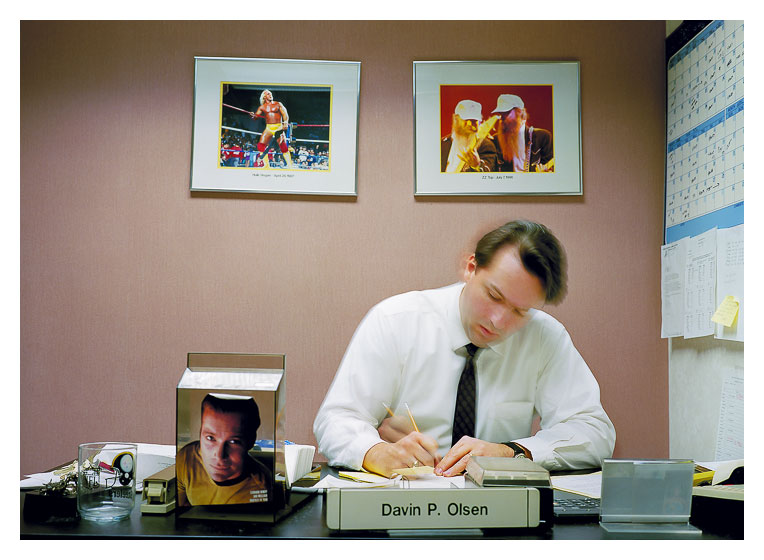
When I'm not buying photo books, I'm a compulsive purchaser of old photography magazines. There is so much inspiration to be found in the glossy pages of back issues and every once in a while you find hidden gems by a photographer you've never heard of before. This past winter I bought a copy of the summer 1997 issue of DoubleTake and had one of those wonderful moments of discovery. The photographer was Steven Ahlgren and the work was from a series examining workplace environments.
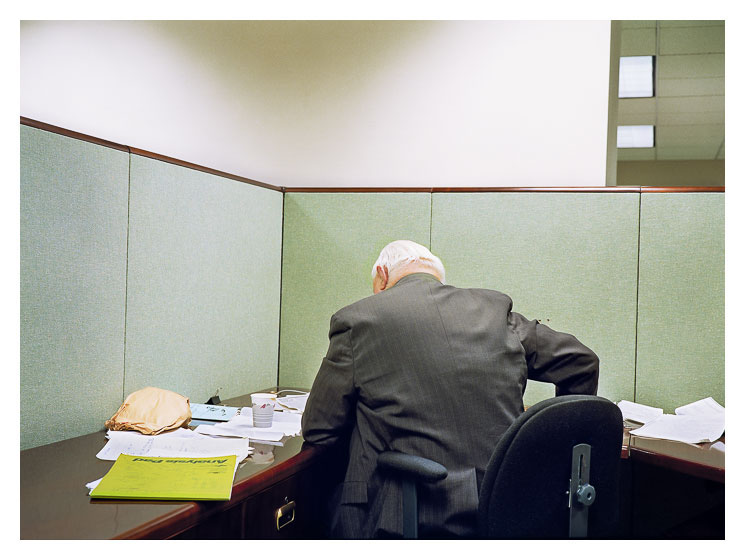

Accounting Office, New Haven, Connecticut © Steven Ahlgren

What immediately struck me about Steven's photographs was they seemed like they could have been made last week. I went straight to Google to find as much information as I could about his work and career since the piece in DoubleTake. Funny thing was, Steven Ahlgren was nowhere to be found. There was no portfolio site, no recent news stories about exhibitions and no blog posts about this amazing photographer. The only mention I could find was a 1993 New York Times review for a show at the International Center of Photography. The ICP show featured names like Cindy Sherman, Laurie Simmons, Richard Prince, Barbara Norfleet, John Pfahl and Lee Friedlander, but the Times paid special attention to Steven's photographs saying they had a "somber and evocative directness."

I dug a little deeper and found a notice for an Introduction to Digital Photography course taught by a Steven Ahlgren at the Media-Upper Providence Library in Media, PA. I emailed the librarian explaining who I was and asking if he could put me in touch with Steven. A week passed and I was beginning to give up hope when I received an email. It was him. He was the Steven Ahlgren I was looking for.

Steven's work had blown me away and I wanted to learn more about his process, but I was also curious how a photographer of such obvious talent found himself on the outside looking in at the contemporary photography scene. I asked Steven if he would be up for a quick interview. I was very happy when he agreed and shared his newly launched portfolio site.


Bullet Holes, Insurance Office, Newark, New Jersey © Steven Ahlgren

AMY STEIN: My journey to photography was very much a reaction to my experience with the corporate world. I found it insulating and uninspiring and decided to shift my career towards something that would excite my interests in the world outside of the glass buildings and cubicles. You came to photography after working as a lending officer at a bank. What was it about the corporate experience that compelled you to come back and capture life amongst the copy machines and fluorescent corridors?

STEVEN AHLGREN: When I left banking after five years I really had no immediate intention of going back to photograph that world. I was frankly kind of bitter about the years I spent behind a desk, thinking it was all wasted time, and I didn't want to dwell on it any further. I did however have many vivid visual memories from the office - of dramatic light in hallways and tense faces at meetings, but still I didn't really consider it as a subject. It was only after a few years went by and I had the opportunity in graduate school to earn extra money photographing "networking" meetings - where business people meet after work socially to exchange cards and make contacts - that I began to think about it as a subject. I had also by that point come across the work of several photographers who had photographed the office that got me thinking about it. I still retained some strong (mostly negative) feelings about the time I worked in offices, and those probably contributed to a desire to try and address it as a subject as well.

My first attempt to photograph the business world was photographing these social events, but I felt the need to make the work more conceptual and more critical. I thought the images needed some help to get their point across so I would also photograph selections from pages of various "how to succeed in business” advice books and combine the images and words in black and white prints. The results were satisfying at the time, but the appeal didn't last. Soon after these images seemed overly satirical, caustic, and simplistic. I realized my feelings toward the office, and also to those people who work in them, were a bit more complicated and sympathetic. So I later dropped the text and wrestled with the much harder task of making meaning with just pictures. I also then decided to switch to color - partly out of an instinct that it was better for the subject, but also because I had not photographed a lot in color up to this point and I wanted an excuse to figure it out by working with it.


Commercial Bank, St. Paul, Minnesota © Steven Ahlgren

I liked these new images better, but soon after I decided that the only way to properly address the topic of office workers was to photograph them in their offices. Getting access was the biggest difficulty, but I continued to attend these networking meetings and ask people if I could make some portraits of them at work for a personal project. I told them they wouldn't have to pose or do anything special. I would only use whatever light was there. Just let me set up a camera and watch them as they kept going about their routine. As you might expect most people would decline, but others were open to it. I first spent a few months using color negative film in the same Leica that I used for the networking meetings, but was never satisfied with the prints. So I bought a 6x9 Fuji and that was the thing that did it for me. Finally with the bigger negative the images began to approximate what I was seeing and feeling in these interior spaces. The quietness of the images seemed more pronounced. The light and color were much more evocatively described. I've always photographed by available light and this larger size negative seemed to work better with this. It was exactly what I was after. I suppose it was a good lesson of the importance of using the proper tool for a particular job at hand.

AS: What I love about your series is that the photographs seem very much of the time and yet very relevant now. Save for some outmoded haircuts and computer equipment, the photographs you took 15 years ago could just as easily been taken last week. The same dead stares at the desk. The same polite unease in a meeting. The same subtle power maneuvering between middle managers. What do you think is it about the office environment that makes the experience so consistent over time?

SA: I guess in part it's because the nature of the work itself hasn't changed much. Office work is still primarily about gathering, analyzing, and sharing information. These days of course that information mostly resides in a computer, which for some reason seems to be one of the few markers of time in an office picture. Office furniture seems curiously impervious to redesign - either in form or color palette. And office work is still done by people with all the forever-inherent complications, tensions, resentments, anxieties, etc. that arise when people are organized into a hierarchy and given a task to accomplish.

I have to mention here as an aside how much my working life has changed since these photographs were made. It's ironic to me that now I spend a good deal of my "photography" time working on the computer, probably not looking much different than one of my subjects. One of the reasons I left banking was because I wanted to spare myself from a lifetime of looking at a computer monitor.


Federal Investigation Agency, Leesburg, VA © Steven Ahlgren

AS: When I see photography about office work I am almost immediately reminded of Lee Friedlander's At Work series. Were you aware of these photographs when you started your series? Which photographers inspired you when you were starting out? Which photographers inspire you now?

SA: As a longtime admirer of Lee Friedlander's work - not only his office photographs but even more so his other subjects - that's nice to hear. Friedlander was one of several photographers who addressed the office as a subject that I admired early on, although when I started my series the only ones of his I had seen was a group of photos he did for MIT that showed various workers staring into their computer monitors. He hadn't yet gotten his Hasselblad with the super-wide lens. The other photographers I saw early on were Chauncey Hare, Dan Weiner and Anna Fox. Hare's book This Was Corporate America (published around 1984 I think) was a sort of confirmation that the subject was worthy of serious exploration. Dan Weiner's book America Worked also served that purpose but with a more sympathetic and subtle take. Anna Fox had some office photos from a series called Workstations published in an issue of Aperture in the late 80's focusing on contemporary British photography and her work remained with me as well. But I should mention that probably the biggest influence on me for these photos was actually done by a painter and not a photographer. Edward Hopper's Office at Night has as long as I can remember been one of my favorite paintings. I love the quiet tension in the image, which shows only a man at a desk and a woman standing nearby.

These days I've been looking at recent work (not of the office) by Michael Schmidt - especially Irgendwo - and also Paul Graham. I've also been looking a lot at Rembrandt's self-portraits - no doubt due to some mid-life thing on my part.
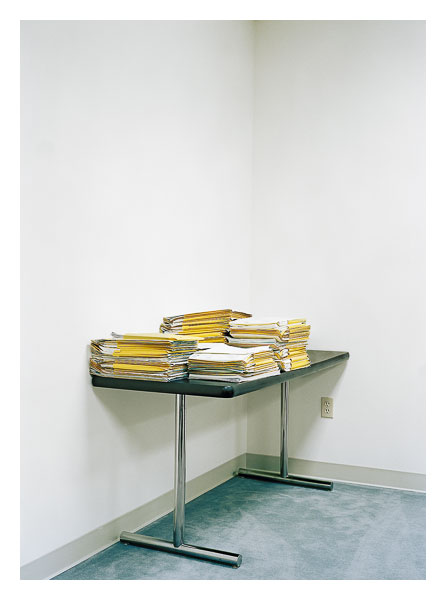

Commercial Bank, Duluth, Minnesota © Steven Ahlgren

AS: Have you seen any of the more recent office projects like Eric Percher's Work or Lars Tunbjork's Offices?

SA: I have seen few of Lars Tunbjork's office images. I have not gotten my hands on the book he did of the subject. I like some of them very much, although they seem in a different place than mine. His approach seems a bit more witty and colorful. More Martin Parr-ish. Eric Percher's work, which I had not seen prior to your mentioning it, is likewise rewarding to view. I recently looked at his web site. I am most interested in his still life's.

AS: You worked on Going to Work for most of the early 90's and received a good deal of attention for the series including a group show at the ICP that was reviewed in the New York Times and the feature in DoubleTake magazine. I think most photographers live in a constant state of paranoia that their last success might be their last success. I would love to get a sense of how you viewed your successes at the time. Is that what you were gunning for in your career or were you not even thinking of museum shows and magazine profiles when you first picked up a camera?

SA: I was very happy for the photographs to get the attention and those are the kind of places I had hoped to have them seen and discussed. I hoped it would be the opening of having the work seen more widely, although that was not to be the case - due in part to lack of further positive response from many of those I later showed the work to, as well as a lack of persistence on my part. Hopefully on another go around I can get the work seen in a few more places. Last year I reprinted the portfolio of this work as inkjet prints and I found when looking closely at the work again now that it has (for me at least) weathered time well. As a whole the images still feel true and I find them relevant today. Interestingly many of the images in the series were made when the economy was rapidly growing.

AS: After Double Take you maintained something of a low profile on the photography scene. Where you still taking pictures?

SA: I kept working on it through the 90's and I added to the project by moving outside to explore corporate pedestrians - mostly on Wall Street - in tandem with a group of images of architectural details of corporate office buildings. After working so much inside I think I wanted to get outside in the daylight again. Also these latter two projects didn't require obtaining access. The subjects were there whenever I wanted to work on it. These outside images were only seen once at a now defunct on-line magazine called "word.com". I also started and abandoned several projects - a series on the New Jersey Meadowlands (which someone recently published a book on) and another series on weeds (I think this subject is still virgin territory in terms of a book). Around this time I began doing editorial work since, despite some early success in the art world, I was getting a better response to my work from editors than from curators and galleries. I also found appealing the chance to get paid (more than I was earning adjunct teaching) to travel around the country to make photographs.

Then my personal life changed dramatically in June, 2000 with the birth of the first of my two daughters and the relocation of our family to outside Philadelphia where my wife and I bought a charming yet thoroughly dilapidated old house. Most of my waking hours were soon taken up between tending to the girls and renovating the house to be somewhat habitable - both of which activities I confess to have thoroughly enjoyed. Now however the girls are in school for more of the day and the house, while still needing work, is a bit more under control so I find I can now begin to get back photography again.


Air Intake, Office Building, New York City © Steven Ahlgren

When I did have free time over these past years I spent a good chunk of it trying to figure how to make prints on the computer - kind of relearning photography - which has been a mostly satisfying experience mixed in with periods of extreme frustration. This seems to be the natural order when humans and computers interact. Today I am in the process of completing a web site and beginning to make a maquette comprising and combining all three corporate projects.
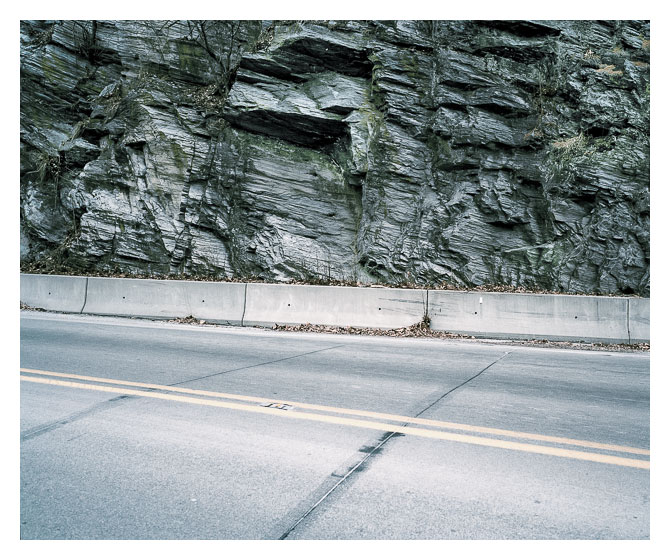

Sidewalk, Wilmington, Delaware © Steven Ahlgren

AS: What's next? Do you have any new work planned?

SA: I've begun working on a series whose tentative title is Autocratic Landscapes. I am fascinated by the primacy of the car and what our fealty to it yields in terms of the landscape we pass through on a daily basis, in addition to how it effects our architecture and our relationships to each other.
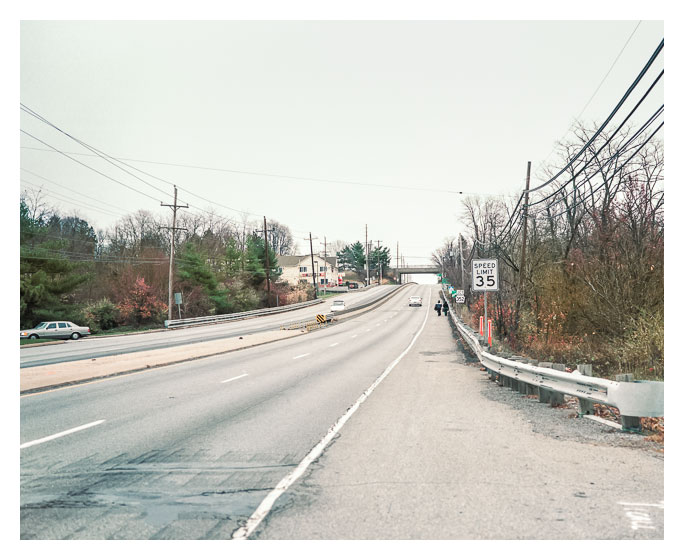

Laundromat, Broomall, Pennsylvania © Steven Ahlgren

AS: Do you have any advice for young photographers?

SA: I was recently reading an essay about Harry Callahan, and there was a recollection by a former student of how he would always say to just go out and do the work, even if your not sure where it's going. Get up and do some work, any work, and something may come of it. Make something and react to what you've made in order to find a path. That seems like pretty good idea.

Another piece of favorite advice, or perhaps it's more of an admonishment, comes from Walker Evans: "Stare, pry, listen, eavesdrop. Die knowing something. You are not here long."

Friday, May 08, 2009

1000 Words/1000 Pictures


Corinne Rose runs the Talkin' Back program at the Museum of Contemporary Photography. She was kind enough to send me words and pictures from their recent 1000 Words/1000 Pictures project. This is really amazing.


Talkin’ Back: Chicago Youth Respond showcases the work of Chicago youth who respond to major issues and ideas impacting their lives and communities through photographic images and creative written expression.

Among the projects on display is a collaborative installation, 1000 Words/1000 Pictures, that creates a collective voice of words and images gathered from the two hundred students from schools throughout Chicago. Students took 1000 snapshots interpreting the theme of Human/Nature. Participating students have also generated 1000 descriptive words in response to the photograph, In Between (2006) by Amy Stein, from the MoCP’s permanent collection.

In Between © Amy Stein
Here are the students' 1000 words inspired by my photo:
long road hiding passing by sadness looking back middle of nowhere highway hidden baby lost pink-eared hungry looking little running will not grow up fur no way out no one knows no where to go protected for now gray alone sad emotional fearless paradise fall artificial nature luminescent strip mall twilight lifeless humanity abandoned community failed suffering confused global social justice oppressed savages yuppies hipsters rising phoenix La Frontera ambition thrive unstoppable si se puede Obama caged in nature gentle lamb road kill born to be run over the road to road kill Bambi nature’s road ahead escape green wonder dew mystical weird life cut off gateway world barrier wisdom wonderful sad night afraid eerie paradise confused death one more casualty worried lonely wildness murals reflection brainwash solitary stuck photographer will you save me looking spotted fawn rusty metal cold misty highway weeds distant glow relationship to nature motherless isolated trucking past lanes prairie island hairy fluffy green hills happy scared dangerous scene headlights hazard fear timid family farm Disney’s road to fantasy Highway 38 risky flowers ghost cars soon it will be dark or is it morning drivers shoppers unaware desolate road cars fence trapped deserted road to nowhere fast spirit natural remote cut off tropical in the weeds how did I get here? where is he going? wild horns wondering wrong turn I’m lost where are my friends? no one to save me will not see sunrise Incarcerated by machines, nature hides and seeks for salvation. the wind causes nature's pleas' for help but it's lost in the noise of pollution. hidden life among the metal is the pleasure our eyes unconsciously desire. It's a feeling that only loneliness can understand. the seeking of a life and the world neglecting. you are so close to my heart. the rushing surrounding around me and the silence that awakens. Keep me close to your heart. let that single spot of sunlight touch you...and brush your head. the worst kind of union. the whisper of the leaves, that are overpowered...the truck horn blasts, scaring the sweet chirping of the birds away...hypocrisy. the animal looks lost. almost like if it doesn't belong where it is. so close to the human world. people in cars are passing by while there in the middle of the unknown. it is afraid of moving forward but afraid to stay behind. I see an animal looking straight ahead He is white and looks scary escaped from where it belongs headed towards the road little lonely in trouble the owners are looking for him boring looking at me he intimidates big ears stand out he might jump out of the picture he had paint on his face there are so many trees the sky is so blue his skin is so white albino deer with a black stripe running through his head rural area houses European style farm someone is washing dishes someone is making a picture a baby is crying someone is in the hospital someone falls to the ground someone crashes someone looks at the sky no one knows the fate of the deer the deer is looking at me there is a farmer picking vegetables it is spring a little kid plays outside a baby is being born someone is dying someone is afraid he is taking out the trash someone is working kids are in school someone is drinking someone is on a computer the weather is nice people are hunting someone is taking pictures someone is on the beach I was in school my mom was at lunch my grandma was burning lipstick my brother was sleeping my sister was in my room my grandpa was at the store; Human Nature: walk/trees are in the photo with Mr. McDonald; work/jobs are wide and scary; talk/worms are busy bees; breathe/rocks help the air stay calm; eat/roots are a good nutritious breakfast; blink/soil gets into peoples eyes; fight/dirt is hard to wash out of school uniforms; move/grass can be slippery; blink/animals move faster than the eye can see; sniff/rocks open 24/7; drink/worms get fat off milk and honey; sleep/grass is very comfortable; snow/love is best in the Summer; sidewalk/runs three times a day to burn off calories caused by the sun; write/sky is a poem. Natural/Human grass/cries when it rain hit it dirt/kisses whenever a tire drives through a rain puddle soil/thinks what to do and how to do it and how to get water so rich to help the plants grow so that they can live more and more rain/listen to everything; leaf/moves are very slow; wind/blows are strong and beautiful; rock/builds become skyscrapers with vines; grass/writes whenever someone walks across it and leaves a footprint; flowers/sing because sound lets you know when something can move; stone/shakes at the touch of someone cute sky/jumps to be taller than mountains; sun/smiles when you wake up in the morning to a sun so bright, it makes your eyes squint which makes it hard to write Mr. Young’s poem

Wednesday, May 06, 2009

Tonight I Party, Tomorrow I Pack

Midway, London, Kentucky © Susana Raab
My foyer looks like a yard sale right now. I have pulled out and piled clothes and equipment, cords and books, computers and toiletries in a mad attempt to fit it all in my suitcase and take it with me to Denmark this Friday. Things are anxious to say the least, but that doesn't mean I can't maintain my usual New York art scene schedule.

Tonight, I will be going to the opening reception for the Affordable Art Fair and then over to Tribeca for the NYMPhoto Group Show opening at Sasha Wolf Gallery.

The NYMPhoto show at Sasha Wolf will be full of impressive work by a number of talented photographers including dear friends Juliana Beasley, Tema Stauffer, Nina Corvallo and Susana Raab.

Three years ago my work was featured in the SVA booth at the Affordable Art Fair. It was the first time my prints were presented in a market context and the first time they received a measure of public recognition. I would highly recommend stopping by AAF this week and purchasing the amazing work of current students and recent grads from the School of Visual Arts. And, while you're there, stop by the KlompChing Booth and check out the work of Lisa Robinson, Simon Roberts and William Greiner.

Jeongmee Yoon and Her Black Things © Jeongmee Yoon
Also, if you are in San Francisco this Thursday, you must go to the opening reception of Jeongmee Yoon's show at Jenkins Johnson Gallery. Jeongmee's Pink & Blue Project is gorgeous and must be seen in person to really be appreciated. Plus, she is as sweet as sugar cake. If you go, please tell her Amy said hi!
Related Posts with Thumbnails