

Sunday, July 31, 2011
Monday, July 25, 2011
How I Learned to Stop Worrying and Love Sharing My Work Online
© Anneke Joris
Blake Andrew's post about the unauthorized proliferation of Melanie Einzig's photograph of a man knitting on the subway highlights an all too familiar tension between content producers and content sharers in the age of social networks. The reality is that if you live and work as an artist on the web you are choosing to both exist in a constant grey area between copyright law and Fair Use and participate in a vast frontier of wobbly ethics that vacillate depending on the network, community or individual. Einzig's desire to maintain full control over the use of her images is admirable, as is Blake's call to the blogosphere to help remove all unauthorized uses of the photograph in question, but it does seem a bit like spitting into the social wind.
Don't get me wrong, I fully support the proper attribution of images and have done so on my blog since day one. In the age of Google Image Search, there is absolutely no excuse for not crediting an artist. But, I'm also a realist and long ago I fully embraced the idea that my images will travel and that's not necessarily a bad thing. In fact, it's mostly a very good thing. If someone is moved to share my work or inspired to use it to create something new, that's kind of cool. I know the free flow of my images has certainly helped my career and I often tell my students to swim with the current and make their work as shareable as possible.
I have found my images in every nook of the Internet, mostly attributed and not altered in any way, but often unattributed, remixed, appropriated as paintings or drawings and cropped in ways that offend me to no end. Every time I come across my work presented like this, I cringe a little, but most of the efforts are benign and nobody is profiting off my intellectual property. When someone is profiting, I shut that shit down.
I understand the photographer's desire to manage use of her images online, but that became damn near impossible once the web evolved from a destination medium to a networked medium. You can't stop the flow of information. You basically have two options: don't post your work online or do so with the knowledge that interesting images will inspire people to share and alter them in ways both good and bad.
I believe it's important for the arts community to lead by ethical example on this issue, so to that end I solute Blake's efforts. However, in the spirit of not clogging the flow and respecting the talents and value of artists, I propose a slight modification to Blake's call to activism. Instead of stripping the images from the web, let's reach out to the offending posters and ask them to credit Melanie Einzig as well as any and all works they include on their sites in the future. Let's create a kind of attribution Neighborhood Watch where we confront site owners, editors and publishers that post images without crediting the artist and kindly ask them to get with the program. If we all have each others back on this our little photo community may be able to bring attention to the work of otherwise nameless artists and bring some ethical order to the wild frontier of the social web.
Friday, July 15, 2011
The Future of Photography, Again

Google Street Views © Jon Rafman
Future of photography exhibitions always intrigue me. I find them interesting not because they give me wormhole access to content that lives just beyond art’s event horizon, but because the exercise of curators lusting for predictive immortality while displaying a passive hostility towards the status quo they've created makes for curious sport.
Most of the future of photography conversations inevitably end up being about the now of photography. And the now of photography, like all trending things, rarely ends up being the tomorrow of photography. The now of photography is about the proliferation of images, digital manipulation and photography about photography. Like all art, now photography is reactive commentary on the world we live in and of the styles and processes that came before. If five years from now people are still appropriating images from Google Street View will we say we are living in the future?
Monday, June 27, 2011
Photography Commons
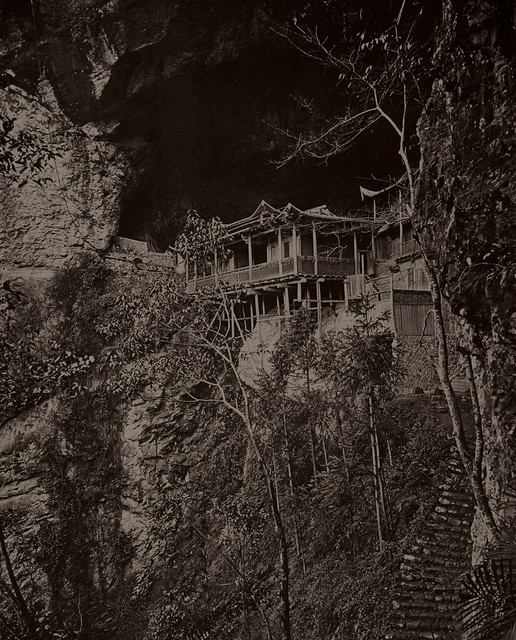
Yuen-Fu Monastery, Formosa, 1870, John Thomson
One of the great joys of the past few years has been the movement by museums, libraries and archives to digitize and make accessible hundreds of thousands of photographs in their collections. It amazes me how little The Commons is discussed in the endless debates about the pros and cons of digitization. Never before have so many images by masters and commoners been accessible for study, inspiration, education or appropriation. My new favorite site, Indicommons, aims to make these photographic commons more well known.
Monday, May 23, 2011
No Direction Home

Kylie, Stockton, California © Alec Soth
I'm happy to have a few of my Stranded images among such good company in No Direction Home, an exhibition for the curated by good friend Stacy Mehrfar for the Head On Photo Festival. The show focuses on contemporary interpretations of the tradition of American road photography.
The details:
No Direction Home
Curated by Stacy Arezou Mehrfar
Featuring work by Alec Soth, Amy Stein, Brian Ulrich, Doug Rickard, Justin James Reed, Naomi Harris and Stacy Arezou Mehrfar
May 24th - June 4th
Depot II Gallery
2 Danks Street
Waterloo NSW, Australia
Opening Reception: May 24, 6-8pm
Saturday, April 09, 2011
Sidney Lumet RIP
The great American director, Sidney Lumet, has passed. A master of social realism, Mr. Lumet's filmography includes some of the great titles in the history of cinema.
Sunday, March 06, 2011
Spoek Mathambo and Pieter Hugo Collaborate on New Video
The new video from Fader favorite Spoek Mathambo is a cover of Joy Division's "She's Lost Control." If the video feels hauntingly familiar perhaps it's because Spoek collaborated with South African photographer, Pieter Hugo, to pull it off.
(Hat tip to Michael Itkoff.)
Sunday, February 27, 2011
Perfect Match
UPDATE: And still yet another 'match'. Commenter, BabyCakes, points me to the image below made by Melvin Sokolsky in 1960.
A portrait of Salma Hayek by Cass Bird appears on the cover of the 2011 Women's Spring Issue of the New York Times T Magazine. When I saw the image, I immediately thought of Josephine Meckseper's photograph Pyromaniac 2 and I tweeted that the T Magazine cover was clearly a "ripoff."
Well, I've been around the art world long enough to know that everything is a ripoff. Or, more accurately, everything is derivative of something else and that's what keeps art alive. Sure enough, @KennethJarecke responded to my tweet and reminded me of Douglas Kirkland's famous portrait of Jack Nicholson. And so it goes...

Salma Hayek, 2011 © Cass Bird

Pyromaniac 2, 2003 © Josphine Meckseper

Jack Nicholson at Home, 1975 © Douglas Kirkland
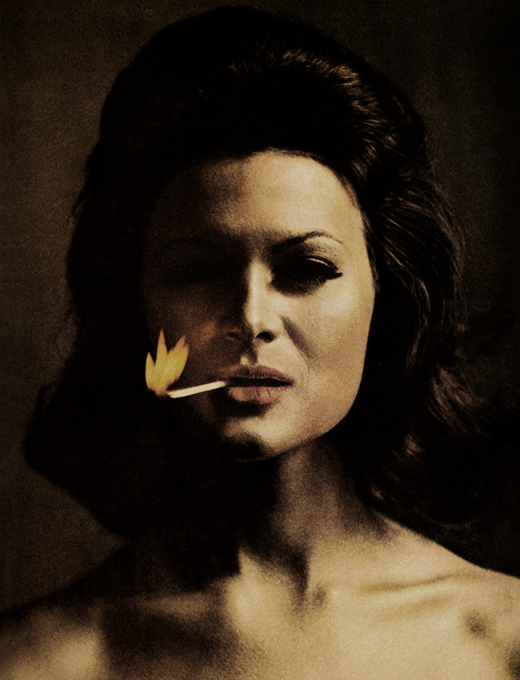
Isabella Match, 1960 © Melvin Sokolsky
Monday, January 31, 2011
Vivian Maier Goes Mainstream
I first wrote about Vivian Maier in 2009 and since that time she has been discovered and canonized by street photographers around the globe. With a new book of her work slated for release this fall, a documentary about her discovery and retrospective at the Chicago Cultural Center it looks like she is finally getting the mainstream attention she deserves.
CBS video via Art Most Fierce.
Saturday, January 29, 2011
Doug Dubois
Great interview with Doug Dubois by Sunday & Wednesday. Doug is a national treasure and a great friend.
Via Liz Kuball.
Thursday, December 16, 2010
A Few Questions for Jo Ann Walters

© Jo Ann Walters
I met Jo Ann Walters in the summer of 2002 at the Maine Photography Workshops. I was working as a teaching assistant, helping a different photographer each week in the classroom. That summer would end up being an important one for me personally and professionally. I was new to photography and hungry to absorb as much as I could from the teachers and students who were passing through. Jo Ann arrived toward the end of July and within the first few hours of working with her I could tell that I was in the presence of a naturally gifted teacher and exceptionally talented artist. The week I spent working with her changed the trajectory of my career. She introduced me to the concept of photography as art and steered me toward pursuing an MFA.
Jo Ann is now the head of the photography department at SUNY Purchase, where I also teach. All my students who know her sing her praises as an educator, photographer and person. They respect and admire her, something many of us who teach strive for, to earn the respect and admiration of our students.
I've also admired Jo Ann's work for years and was thrilled when Kris Graves announced that he would exhibit her work in November. I asked Jo Ann if she would be up for a quick interview. I was very happy when she agreed. This post comes late in the show's run. It closes on Saturday, December 18. If you're in New York and haven't yet seen it you have a few days.
Amy Stein: Your show VANITY + CONSOLATION, that opened at Kris Graves Projects and runs through December 19th, is an examination women and girls in intimate domestic spaces in the small blue color town of Alton, Ill. Can you tell us more about this series?
Jo Ann Walters: All of my work, VANITY + CONSOLATION, DOG TOWN, my early landscape work THRESHOLDS and other side projects can in one way or another be traced back to my experiences growing up in southern Illinois in the 1950’s and 60’s and the choices I made in response to my background.
VANITY + CONSOLATION is, perhaps, my most personal work. The pictures are like secrets you tell someone in confidence but might not to everyone. In my introduction to the entire work, made up of approximately 70 pictures, I describe the shock and isolation that I felt as I began to move further and further from home. In addition to Illinois, I’ve lived in New Orleans, Arizona, Maine and Connecticut where I presently reside. These are unique cultural places within the United States. They each resist the bland sameness usually associated with this country and particularly the mid west.
There is this geographical distance, but there is also the emotional and intellectual distance I traveled. These portraits of young women, mothers and their children comes from my desire to remember where I came from, to understand what I have gained by leaving home, and also to see and feel what I have lost by leaving home.

© Jo Ann Walters

© Jo Ann Walters
© Jo Ann Walters

© Jo Ann Walters
One of many ways of understanding VANITY + CONSOLATION is as a covert portrait of a runaway. Alice Munro, one of the finest authors I have ever read, has a collection of short stories titled Runaway. I am mesmerized by the varied associations of the title. For example, “Runaway” is a proper name. It might be read as an archetype. It might also be understood as a secret and internal female voice of warning or command to runaway directed toward the women and girls Munro writes about.

© Jo Ann Walters
There are two pictures in the VANITY + CONSOLATION that suggest this notion of a “runaway” as deep content in the work. One photograph, depicts a young girl on a bicycle riding past a suburban home that might be her own. While passing, she looks back over her shoulder at the front door that seems to be beckoning. It is lit with the gleaming gold of sunset. (Of course, this photograph references two of William Eggleston’s pictures in The Guide. Inside his book, the first picture is of a front door of a suburban home decorated with a basket of artificial flowers and then there is picture of the tricycle on the cover. However, as you move through the sequence of pictures in my work, you see that I reference his work, but use the imagery to different ends.

© Jo Ann Walters
Another clue is the photograph of the teenage girl with chipped blue fingernails wearing a baggy grey sweatshirt. She has this beautiful distorted Inge -like body in the picture. There is an Adidas lanyard hanging from her neck that holds a set of keys. The keys dangle between her thighs. She is sitting on a guardrail. One fictive interpretation might be that she is a teenage runaway. There is a surprising anecdote about this portrait. The young woman in the picture told me that she had just discovered that she was pregnant.

© Jo Ann Walters
I like to work long and hard on projects, often for a decade or more. I want my work to feel like a living thing with many layered meanings, emotional range and depths of feeling. I look thoughtfully and carefully when making pictures as well as afterwards when editing and printing. The constellation of particulars, the details, the associations of the subject matter, the skeletal structure and the color and textures of weather and atmosphere that hold a picture together. And then there is the whole, wonderful puzzle of many images to contend with and to make sense of. I build visual motifs out of these elemental details by weaving them together into what I hope are stories of deep inwardness through strange and beautiful appearances.
The motivation for this work was originally a way of validating the righteousness of my new found life away from the Midwest and the burdens I associated with it; the oppressive religious dictates of Catholism, the intellectual and emotional oversimplification of women, the dictate to be seen and not heard, the inevitable future of children and the narrow range of intellectual work. The Emily Dickenson poem 505 describes what might be at stake by staying rather than leaving, of being created rather than creating.
I would not paint—a picture—But it’s funny though how the world refuses simple characterization. You won’t find consolation in what passes for the new. Rather you will find it in despised places and corners of your imagination. It might be easier to picture what I mean if I can deviate a bit and talk about making pictures for my newer work DOG TOWN. I started by driving around in the bad neighborhoods, photographing vacant lots, railroad lines, burned-out buildings. These are the parts of my hometown that show the deep scars of industrialism. I was looking for something that nobody else wanted anymore, something anonymous, something forgotten.
I'd rather be the One
Its bright impossibility
To dwell—delicious—on—…

© Jo Ann Walters

© Jo Ann Walters

© Jo Ann Walters

© Jo Ann Walters
.jpg)
© Jo Ann Walters

© Jo Ann Walters
By extension, in VANITY + CONSOLATION I try to show the cracks in what seems like an ancient and nearly impenetrable psychic wall of vanity. These are the whorled places that hold the sweet and aching sadness of our desire and beauty.
When I looked back, remembered and gave myself over to search and questioning, I came away with much more than I had bargained for. What was first experienced through distance and fascination, my earliest pictures of this subject attest to this, turned into something far too complex to be depicted solely through irony. Instead, I found the swirl and ache of regret and beauty. I made a picture once, as part of Dog Town, of an empty roadside fruit stand along the highway on one of my many road trips. It had a weathered sign that had once said PEACHES, but the “p” and the “e” were nearly worn away. The first impression reads that it said ACHES before the rest of the word begins to appear. This photograph didn’t make it into the final edit though I printed and re-printed it and tried and tried to make it work. Memory and the sensual are intrinsically linked and in the end I couldn’t breathe life into it. Despite my desire it stubbornly refused to move beyond the illustrative.
AS: As someone who doesn't work on projects so close to home, I always wonder how you (and photographers like Doug Dubois and Chris Verene, for example) separate your personal interest in the subject from your instincts as a photographer. Or do you? Are you trying to make the intimate universal?
JAW: This is an ongoing dilemma, a paradox really, and elemental tension that I wrestle with. It is a question of separating and integrating at once the complex emotions, associations, memories and conceptual attitudes related to one’s home and family with the analytical and evaluative criteria of judgment. I want to translate and make my beliefs and values accessible to a larger world. The goal I think is to find a visual correlative in the world that translates photographically. I’ve learned to trust my intuitive gifts as well as my intellectual ones. I treat all with equal respect. In my best work you can feel that same genrative tension and conflict. You can see the tension of wrestling to keep all in suspension so I can call on any or all when needed. These oppositions are not so much reconciled as accepted. When I work, I try to hold making, knowing and judging in meaningful suspension and trust that what is necessary will come to my aid. It’s a matter of preparation, practice and attention. Of course this is a gross simplification of the process.
I think reaching for the universal is a kind of a religious impulse. Though I am concerned with the first and last questions of spirit and sensuality, I find meaning and consolation in particulars. I am not so much trying to make the intimate universal as attempting to make the intimate graceful and particular.
AS: Your series Thresholds was included in the seminal book New Color/New Work, by Sally Eauclaire, published in 1984, which places you among the masters of early color photography, including Stephen Shore, Joel Sternfeld, Mitch Epstein and William Eggleston. As one of the few photographers celebrated for color photography during this time did you have the sense that your work was challenging the conventions of art photography? Was there camaraderie among your contemporaries that spoke of this movement and pushed the work towards greater acceptance?
JAW: Challenging convention? Certainly not at first. I grew up in southern Illinois in a working class town. I had little access to or knowledge of a visual creative world. I went to schools too poor for art classes. I became interested in photography after I graduated from college. My mother and I took a photography class from a high school shop teacher in a neighboring town that had grown up around oil refineries. These same oil refineries have since become part of my current project DOG TOWN.

© Jo Ann Walters
I moved to New Orleans and had a friend from Arkansas that had grown up on a soybean and peanut plantation. He had been in New York City on business trip and returned with a gift -- William Eggleston’s The Guide. He said Eggleston’s pictures looked just like where he had grown up. Eggleston’s work was strange, fascinating and opaque. I looked at it over and over again for many years. But it was really a combination of Eggleston and Atget that set the wheels in motion. I saw an exhibit of Atget’s gardens curated by Jackie Onassis at the old ICP that set the wheels in motion. I still remember the dizzying affect Atget’s photographs had on me, as well as, the four exhibitions of Atget’s work curated by John Szwarkowski for the Museum of Modern Art. Eggleston and Atget! Strange bedfellows? Maybe, maybe not.

© Jo Ann Walters

© Jo Ann Walters

© Jo Ann Walters
Was there camaraderie among your contemporaries that spoke of this movement and pushed the work towards greater acceptance? Though I eventually met and was mentored by other photographers working in color, I was from Middle America, younger and female, unlike most associated with the “new color”. I was working in the Midwest far from the cultural sophistication of New York City and went on to graduate school in Ohio. Between academic years I met Len Jenshel at the Maine Photographic Workshops when I was his teaching assistant. He was a great support. It was his unabashed embrace of beauty in color that struck me and caused me to question my own relation to beauty. I had been skeptical of beauty and did not quite know how to distinguish it from sentimentality. William Butler Yeats has spoken to the difference between sentiment and sentimentality. Sentimentality, he says, is the hollow image of unfullfilled desire. This conflict continues to be a subject in my work. I make subtle distinctions between the two. Joel Sternfeld’s work was amazing! The beauty, restraint and surprise. He wrote for my Guggenheim application. Richard Misrach use of color was intensely beautiful, minimal and atmospheric. Desert Cantos has a literary component that the best of the work associated with this period of color share.

© Len Jenshel

© Joel Sternfeld

© Richard Misrach
It wasn’t until I began my very first teaching position at Yale University in 1985 where I taught for 8 years, that I came to truly understand the photographic world as part of a greater cultural debate and the aesthetics of color as part of a contemporary landscape movement. Shortly after my hire I won a Guggenheim Fellowship to travel and photograph alongside the length of the Mississippi River. During that time I met and had the exceptional opportunity to live with the Eggleston family in Memphis, Tennessee for several months, and to use their home as a base while I photographed in the south. I looked at hundreds of Bill’s photographs and had long, concentrated opportunities to discuss my work with him. We shared an experience of growing up outside of New York City, in isolated regions of the country. Southern Illinois is at once middle and southern. Much of southern Illinois was pro-confederacy during the civil war. The citizens of my hometown stoned an abolitionist journalist to death. At the same time, there was an underground railroad that transported runaway slaves to the north.
I am not savvy in business, though I suppose it wouldn’t be a bad thing to improve in this regard, that is, as long as I stay true to what I believe in. This is easier said than done. I have been and remain on the fringes commercially speaking. I am also on the outskirts imaginatively. This is good. Imagination (“Poetry”) flows "From ranches of isolation… /Raw towns that we believe and die in.” I concur with W.H. Auden above and William Carlos Williams below.
Look at
what passes for the new:
You will not find it there but in
despised poems
yet men die miserably every day
for lack
of what is found there.
Thursday, December 02, 2010
Stranded at NADA

Cheerleaders, New Orleans, Louisiana © Amy Stein
I am equally mesmerized and repulsed by art fairs in general and the annual Miami art fair fete in particular. I love the opportunity to see so much work in one place, but often it is presented without context and the whole air of commerce can be overwhelming. It's a love, love, hate, love kind of thing for me.
Sadly, this year I will not be heading south for the fun and sun, but my work has made the trip. Pool Gallery has made the long journey from Berlin to Miami and will be featuring a number of photographs from my Stranded series in their booth at NADA. They will also have signed copies of my Domesticated book for sale.
Wednesday, November 17, 2010
Things Fall Apart in Berlin

This Friday Things Fall Apart opens at Pool Gallery in Berlin. The exhibition is my first curatorial foray at Pool and features a stellar lineup of artists. When Pool approached me about curating a show of work that was in dialog with my Stranded series I immediately started to make a shortlist of artists in my head. It was important to me that the show feature all women artists because we are generally underrepresented in the art world and when you make work out in the world, gender plays a significant role in how you react to your environment and how the environment reacts to you. And, it doesn't hurt that most of my favorite photographers happen to be women.
Curating an exhibition is a lot of work (a lot of work!), but I couldn't be more pleased with the show and I couldn't be more honored to have my work hang next to such a wonderful collection of photographs made by such a talented group of artists.
If you are in Berlin, please stop by the opening and say hello.
Here are the details:
Things Fall Apart
Curated by Amy Stein | Works by Juliana Beasley, Lisa Kereszi, Stacy Mehrfar, Justine Reyes, Robin Schwartz, Amy Stein, Zoe Strauss
November 20, 2010 – January 15, 2011
Pool Gallery
Tucholskystraße 38
Berlin, Germany
Opening Reception: Friday, November 19
Wednesday, October 27, 2010
Halloween in Harlem Prints Now Available on 20x200

Untitled (Hulk) and Untitled (Powerpuff Girls) from my Halloween in Harlem series are now available from 20x200. I am a big believer in the 20x200 mission of (limited editions × low prices) + the internet = art for everyone and was flattered when they asked me to participate. For my 20x200 edition I made the decision to offer C-prints which meant hand printing every last photo. It almost killed me, but I am in love with the final prints. Check out the 20x200 site to see (and purchase!) the editions.
Monday, October 25, 2010
Halloween in Harlem and 20x200 This Wednesay

Two photos from my Halloween in Harlem series will be available this Wednesday on 20x200. I can't divulge which images until Wednesday, but the prints look great and you will definitely be pleased.
For my edition I decided to hand make C-prints. Individually printing over a thousand photographs in four days almost ruined me, but I'm very pleased with the final product and happy to be working with 20x200. Big thanks to Print Space and Parsons for helping make my printing death march a little easier.
To get more information and an early jump on purchasing the prints, sign-up for the 20x200 mailing list.
Friday, October 08, 2010
Chinese Mao Impersonators

Thursday, September 30, 2010
Are Fireflies Disappearing?
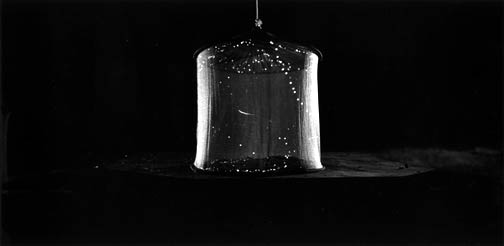
Untitled (19), 1996 © Gregory Crewdson
First it was bees and now fireflies? There has been much anecdotal evidence that fireflies populations are in decline. The Museum of Science wants to know for sure and has started Firefly Watch, a ten year citizen scientist driven mission, to find out.
(Via Treehugger)
Tuesday, September 28, 2010
A Few Questions for Chris Verene

© Chris Verene, 2007
I’ve been familiar with Chris Verene’s photographs since I started graduate school at the School of Visual Arts in 2006. Chris was a critique teacher there, and although I never had the chance to study with him I was always curious about his highly saturated, unsettling and poignant images of his extended family. Chris has been photographing his relatives in Galesburg, Illinois for 26 years. His approach to depicting his family is tender and humorous and often disturbing. His style is distinctive; marked by his use of fill flash, a square film format and the addition of neatly handlettered text surrounding the image.
His exhibition, Family, is currently showing at Postmasters Gallery in Chelsea until October 16. Last week I had a chance to see the show, which features over 41 images densely packed into two large rooms, and to browse the handsome new book of the same name published by Twin Palms. I asked Chris if he would be up for a quick interview. I was very happy when he agreed.
AMY STEIN: I’m interested in your relationship with your family. In particular with the members of your extended family in your images. Are you close? How do you deal with the distance that comes with the repeated act of photographing your family, of placing yourself in the role of observer. Or does the act of photographing them bring you closer?
CHRIS VERENE: I'm very close with my family, pictured and not pictured. As an only child, I clung to my cousins like siblings, and we still are very connected. I do not work as an 'observer,' that is your job as the audience. I am relating the stories from their source, our family, town, and neighbors out to the world at large. I think that the act of photographing makes me close with only the people who really enjoy the photography-- the people who time and again ask for pictures, and compel me to tell those stories.

© Chris Verene, 2002
AS: Your images are accompanied by handwritten text, which gives them context and deepens the narrative of the series. It also mimics the conventions of the family photo album, which is almost extinct. Can you talk about the role of text in your work?
CV: The text is like signing your name on a letter or document. It's one's own writing, and it guarantees that one stands behind what is written. I struggle with the writing every time-- it is hard to do, very permanent, and must be done on every single piece throughout my history. It is the best I can do, but often looks imperfect. It also probably keeps me outside of some curatorial worlds, it's perhaps too weird, too personal, too off-beat in a cool Chelsea world of photo --filled with the slick conceptual object-photos of Roe Ethridge, Oliver Boberg, Sarah Charlesworth, Gursky, etc.
The handwritten text is a rule-- I almost always do it, and I can't escape my thoughts. One key to understanding the text is that it's usually like you said, Amy, it's like a family album-- it tells us why a picture was taken at that exact moment, it tells what was thought to be the story's end at that moment or other key fact that was in our minds when I came to make a picture.
AS: I read somewhere that you were inspired by Arbus. For me your work is reminiscent of photographers who explore family and rural life Nick Wapplington, Shelby Lee Adams and Larry Fink. Can you talk about some of your photographic inspirations?
CV: Well, Arbus was a book I took out of my parents' locked bookshelf at elementary school age. Waplington has not been an influence, but it was encouraging to see that people worldwide accepted him as an artist. Shelby Lee Adams is an influence, as is Emmet Gowin, and Larry was my teacher for 5 great days at a workshop. He's a GREAT teacher, and I like his rule wherein any level of student can study with him, even beginners. I'd say that Nan Goldin's work was not an influence, but when I saw her book in a store (my first exposure to her) I was amazed that people would accept such snapshots as art-- it encouraged me to know that the language of a small flash camera and everyday moments were high art, because that's what I was already doing in the 1980's.

© Chris Verene, 2005
AS: Some of your images comment directly on the diminishing choices of people living in smaller, economically challenged communities like Galesburg. For example, your cousin Cindy and her husband lost their jobs when the Maytag local factory closed down. There was a time in our country where you could comment about economic hardship without it seeming like an overtly political statement. Today, in this hyper-polarized climate that's harder to do. Did you intend these images to be overtly political?
CV: Naw, it's just a sad fact. I am a documentary artist, so I just have facts to show. The North American Free Trade Agreement meant that Maytag could make their fridges about 10 feet across the Mexican border, and make so much more money, because the people in Mexico will work for a lot less money, and the safety restrictions are very shallow across the border--which also is good for corporations' profits. For Candi and Craig, who both worked at the factory, it meant a carefully balanced life of two working parents with young children was dumped quickly for corporate cash. Galesburg workers were suicidal. Their pensions were dumped, their dreams wasted. My grandfather was cheated out of his railroad pension through similar corporate tricks. It's not politics, it's corporate greed and shifty accounting. I could go on-- my cousin worked for Wal-Mart for 20 years and still has no benefits, they keep scheduling her for 38 hours per week-- she's 'freelance'-- but when Wal-Mart started to carry groceries, she was forced to sign a non-compete clause, which meant she had to quit her other job bagging groceries-- because that breaks the non-compete clause... I could go on...

© Chris Verene, 2004
AS: I knew your Family series was a long term project, but I had no idea that you had been photographing for 26 years. That sort of long term commitment and relationship to your subject reminds me of Doug Dubois, who’s also photographed his family for decades.
CV: Yes, Doug is a good friend of mine, but his pictures are elaborately staged theater, which he makes to look effortless. I much prefer Doug's personal family theater to Crewdson's theater of actors.

© Chris Verene, 2007
AS: What are the challenges and rewards of focusing on one subject for such an extended period of time?
CV: Well, it's all I know. I don't really know what it would be to do someone else's family, or some other such story. I have photographed some special people on assignment for magazines, for example I did a Newsweek cover story on men with Chronic Depression. That's just a few hours with a person.

© Chris Verene, 2006
AS: You’re an educator as well and an artist. Can you talk about balancing those two aspects of your career?
CV: The balance part is just a matter of putting enough hours in the day!! I do love teaching at State University/Westchester Community College-- it's great, and the students are often from a very socially and/or economically disadvantaged background. it is similar to my time spent with teenagers in Galesburg.

© Chris Verene, 2006
AS: What, ultimately, would you like us you understand about family and place by looking at your images?
CV: Ahhh- I don't know what to say! I do hope people will spend some time looking at 50 or more pictures and really look at it before they go too far on their own. I also think reading my essay and my father's essay in the new book are required reading to understand the work.
Saturday, September 25, 2010
A Line Describing The Sun
William Lamson is a fellow POCer and one of the most original, witty and creative artists working today. For his latest project, A Line Describing The Sun, William has finally scaled his genius to its appropriate size.
A Line Describing the Sun involved a day long performance in which I followed the path of the sun with a large Fresnel lens mounted on a rolling apparatus. The lens focuses the sun into a 1,600-degree point of light that melts the dry mud, transforming it into a black glassy substance. Over the course of a day, as the sun moves across the sky, a hemispherical arc is imprinted into the lakebed floor.
A Line Describing the Sun is on display at Pierogi in Brooklyn through October 10.
Subscribe to:
Posts (Atom)
