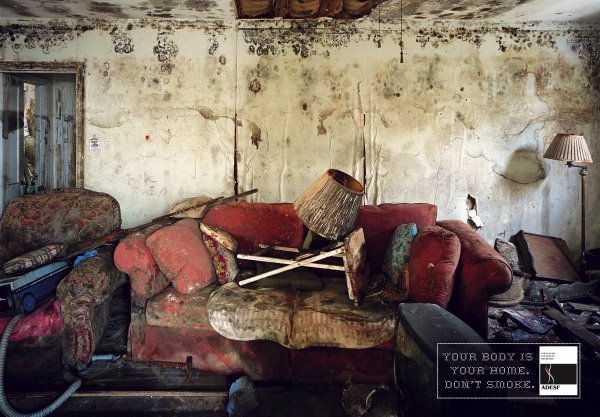
On Gallery Hopper, Todd Walker points to an award winning anti-smoking campaign that uses Robert Polidari's Katrina photos to make a visual metaphor to the body of a smoker. As Todd mentions, the whole idea of tragedy as art is off-putting to begin with, but this campaign takes it down a rung on the good taste-ladder.
The effectiveness of this campaign relies on the target audiences' lack of knowledge about the origin of the photos. They are merely photos of dirty and upturned homes, not controversial images from ground zero of the greatest natural disaster in the history of the US. In making the choice to compare the flood ravaged homes of the working poor to the body of smokers, the creatives made the choice to negate the experience of the individual homeowners and all the residents of the Gulf Coast affected by Katrina.
Don't get me wrong. Cigarettes are a major public health problem and I am a fan of innovative campaigns that manage to break through the clutter to address individual use and expose the evil nature of the industry. But, this campaign trades a disaster for a problem and in the process manages to devalue both.
Am I overreacting or does this rub you the wrong way, too?
Labels: Random


9 Comments:
I've always felt Polidori was neither fish nor fowl - sort of an architectural photographer, sort of an industrial photographer, sort of a National Geo photographer with a big camera, sort of an artist (or at least courted as one), so it doesnt really surprise me.
If it had been say a picture by Struth or Sugimoto or Sally Mann (say one of her Body Farm photos), then I might have been more surprised
PS - there's also Bill Greiners take on Polidori's Katrina work
http://fotoarttoo.blogspot.com/search?q=polidori
it is strange to think that Polidori would allow his images of Katrina to be used in this way, because obviously they would have to have the photographers permission. in a way to me this is the strangest question. it makes Polidori's own interest in the disaster circumspect.
btw, i agree with tim regarding the fish/fowl comment. he does seem to be more a commerical photographer, at least to my eye
I feel the same way about it as I do about hearing John Lennon songs in commercials. Namely, I feel like throwing up.
I'm not 100% sure that Polidori would know if the images are being used for this purpose, assuming they have been offered through some sort of agency or his representatives. However, he would know they are on offer to be used commercially. Seems I remember Alec Soth mentioning that he ran across a book that legitimately used one of his images on its cover, unbeknownst to him.
The other thing I wondered was whether it was okay if - IF - Polidori was donating the money raised through this use to Katrina-related causes. For all we know, this is the case.
BTW, in my view, this has little in common with Lennon/Beatles songs being used in commercials. That's one commercial application being applied to another.
Todd -- Given that it's a public service billboard campaign in Brazil for this client, I can't imagine there was much of a budget. Complete speculation, but if there was any donating going on I bet it was Polidori, or his rep, lowering the typical licensing fee for the benefit of an anti-smoking nonprofit.
Unless, of course, this was a showpiece for the agency and they absorbed the licensing cost to get these ads on the awards circuit. If this was the case, I hope some money flowed back to the Katrina victims.
Either way, because of the subject matter, Polidori should have insisted on tighter use restrictions for these photos.
Amy, Thanks for bring this whole topic up , I was unaware of it but I guess not surprised! As a New Orleans native, I was disgusted by the image Polidori made of the dead man and now this. This is another circumstance concerning this work that I have great trouble with expressing in words! Wm. Greiner
yes, bewilderingly bad taste. the use of these types of images for an advertising campaign - be it a nonprofit, or to sell sneakers, is poorly conceived.
i've always felt uneasy with these photos to begin with, and to be honest the book left me more numbed than angered. this use of images only devalues the overall work, and the merit that it had to begin with. what at once seemed compassionate (albeit thinly) now seems opportunistic and economic.
Post a Comment
<< Home